2020 to 2024
Institutional Finance Meets Web3.Designing UX Between Trusted Institutions and Trustless Protocols
When J.P. Morgan’s blockchain division, Onyx, set out to connect these two worlds, my team and I collaborated with them to design the systems and interfaces to make it possible. This work explored new paradigms in decentralized identity and tokenized finance tackling design challenges few had faced before.
The challenge was to combine the trust requirements of global finance with the interoperability and transparency of blockchain, without losing the strengths of either.
Approach
These projects had great breadth and depth, spanning institutional identity use cases, everyday user scenarios, and tokenized asset transactions across currencies and asset classes. I realized early on that having a teachnical understanding A surprising amount of my time was spent deep in the system architecture, diagramming flows, and listening closely in every technical meeting to understand how the pieces fit together. It sat well outside the bounds of typical UX design work, but in the end I realized it was integral to making the eventual interfaces both accurate and usable. A key takeaway for me was that design becomes much stronger when it isn’t siloed from the system it represents. Especially when trust is the product.
Outcomes
- Patent Contributor. Named on a patent for decentralized identity systems enabling regulated, on-chain transactions. View Patent
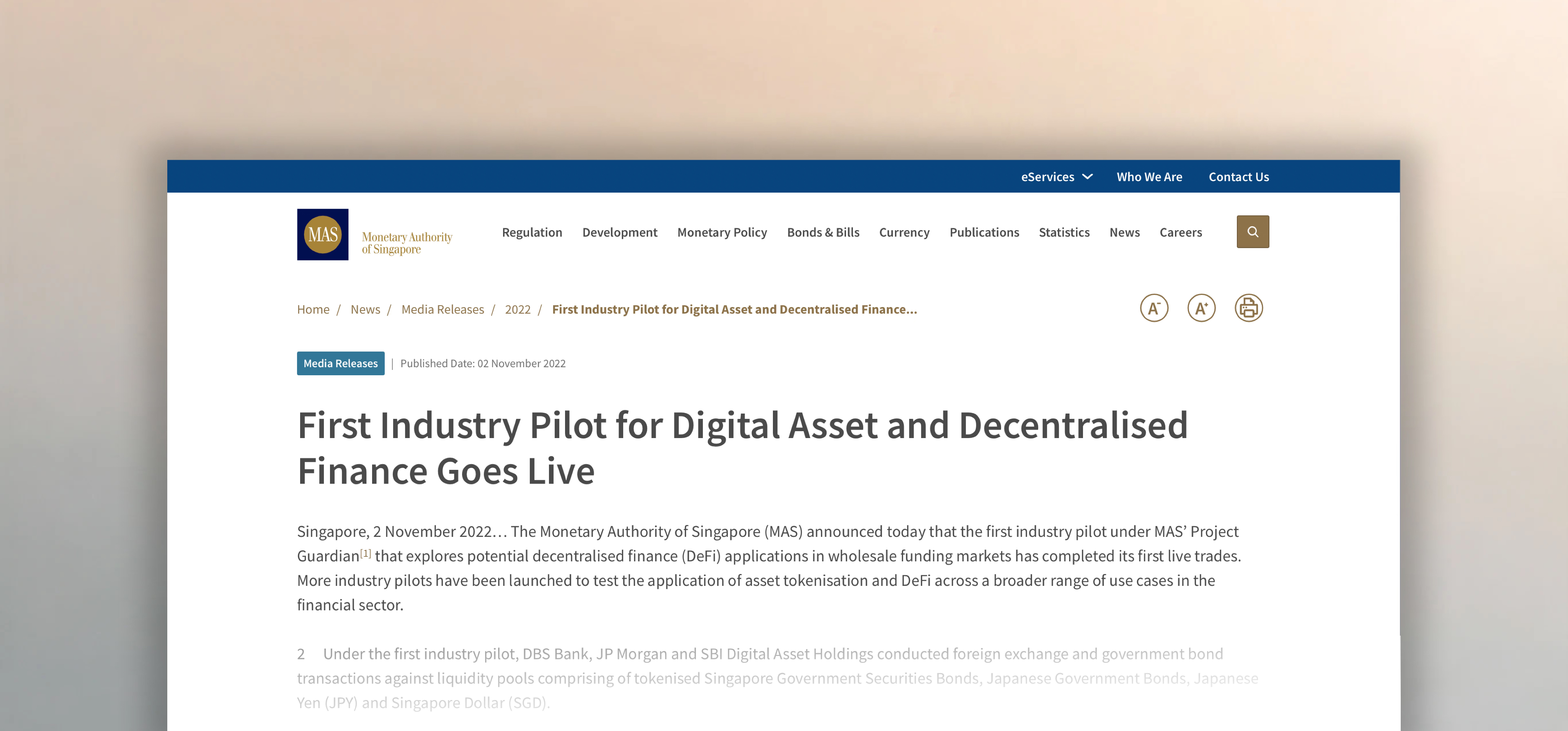
- Industry First. Enabled JP Morgan’s role in MAS Project Guardian, including the first public blockchain trade of tokenized deposits. Read About Project Guardian


2020 to 2024
Institutional Finance Meets Web3.Designing UX Between Trusted Institutions and Trustless Protocols
When J.P. Morgan’s blockchain division, Onyx, set out to connect these two worlds, my team and I collaborated with them to design the systems and interfaces to make it possible. This work explored new paradigms in decentralized identity and tokenized finance tackling design challenges few had faced before.
The challenge was to combine the trust requirements of global finance with the interoperability and transparency of blockchain, without losing the strengths of either.
Approach
These projects had great breadth and depth, spanning institutional identity use cases, everyday user scenarios, and tokenized asset transactions across currencies and asset classes. I realized early on that having a technical understanding A surprising amount of my time was spent deep in the system architecture, diagramming flows, and listening closely in every technical meeting to understand how the pieces fit together. It sat well outside the bounds of typical UX design work, but in the end I realized it was integral to making the eventual interfaces both accurate and usable. A key takeaway for me was that design becomes much stronger when it isn’t siloed from the system it represents. Especially when trust is the product.
Outcomes
- Patent Contributor. Named on a patent for decentralized identity systems enabling regulated, on-chain transactions. View Patent
- Industry First. Enabled JP Morgan’s role in MAS Project Guardian, including the first public blockchain trade of tokenized deposits. Read About Project Guardian




2020 to 2024
Institutional Finance Meets Web3.Designing UX Between Trusted Institutions and Trustless Protocols
When J.P. Morgan’s blockchain division, Onyx, set out to connect these two worlds, my team and I collaborated with them to design the systems and interfaces to make it possible. This work explored new paradigms in decentralized identity and tokenized finance tackling design challenges few had faced before.
The challenge was to combine the trust requirements of global finance with the interoperability and transparency of blockchain, without losing the strengths of either.
Approach
This project had great breadth and depth, moving through phases that addressed decentralized identity for institions, everyday user scenarios, and tokenized asset transactions across currencies and asset classes. A lot of my time was spent figuring out the system architecture with my team, diagramming flows for different types of audiences, and listening closely in every technical meeting to understand how the pieces fit together. This sat outside the bounds of typical UX design work, but a key takeaway for me was that design becomes much stronger when it isn’t siloed from the system it represents. Especially when trust is the product.
Outcomes
- Patent Contributor. Named on a patent for decentralized identity systems enabling regulated, on-chain transactions. View Patent
- Industry First. Enabled JP Morgan’s role in MAS Project Guardian, including the first public blockchain trade of tokenized deposits. Read About Project Guardian